



Your body is speaking a language you can't decode.
Something shifted. You don't know exactly when — but your body stopped being predictable.
Your periods used to show up on time. Now they're early, late, heavy, light, or accompanied by cramps that didn't exist three years ago. Your mood swings have their own mood swings. You're bloated for no reason. Your skin is breaking out like you're 16 again — except you're not.
Or maybe it's a different version of the same story:
- You just had a baby and your milk supply isn't where it needs to be. You're doing everything right and your body isn't cooperating.
- You're in your late 30s or 40s and something has quietly changed — your energy, your sleep, your cycles, your skin, your patience. The doctor says "it's hormonal" but doesn't offer much beyond that.
- You're stressed, overworked, under-rested — and your hormones are the first system to protest. Irregular cycles, PMS that's gotten worse, fatigue that no amount of sleep fixes.
Sound familiar?
Here's what most women don't realise: these aren't random symptoms. They're your body telling you that the hormonal system — the system that regulates your cycles, your mood, your energy, your skin, your reproductive health — is out of balance. And it needs specific nourishment to come back.
Ayurveda identified this problem thousands of years ago. And it built a herb specifically for it.
The herb is called Shatavari — literally "she who possesses a hundred roots." The name isn't accidental. In Ayurveda, it's classified as Stree Rasayana — the women's rejuvenative. The one herb designed for every stage of a woman's hormonal life.


What is Shatavari?
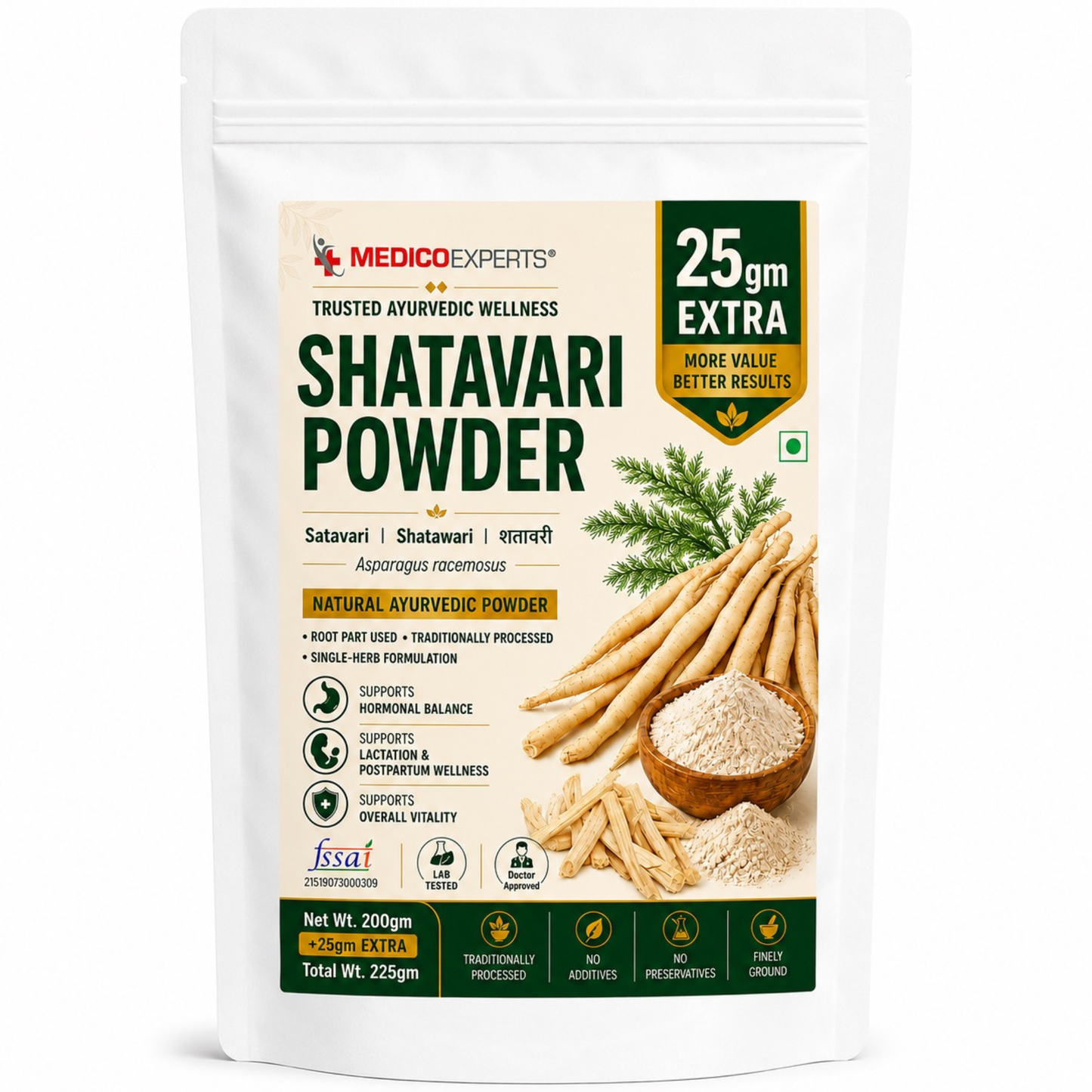
Shatavari (Asparagus racemosus) is the most revered women's herb in Ayurveda — classified as Stree Rasayana, which literally translates to "the women's rejuvenative." No other herb in the entire Ayurvedic pharmacopoeia holds this specific designation.
In Ayurveda, it's the go-to herb for hormonal balance, lactation support, reproductive wellness, and the deep nourishment that the female body needs across every life stage — from menstruation through motherhood through menopause.
It works through a class of bioactive compounds called Shatavarins — steroidal saponins with phytoestrogenic properties that support your body's own hormonal regulation. Not by adding synthetic hormones. By helping your body produce and balance its own.
One herb. Ground into powder. Taken with warm milk, twice a day. Bitter taste — that's the sign it's real.
Why Shatavari — and Not Something Else
If you've been searching for something to support your hormonal health, you've seen endless options — evening primrose, vitex, maca, fenugreek, random "women's blends." Here's where Shatavari sits:
| Primary action | Shatavari | Ashwagandha | Hormonal Medication (HRT / OCP) |
|---|---|---|---|
| Primary action | Hormonal balance through phytoestrogenic Shatavarins + Stree Rasayana action | Cortisol reduction + stress management | Synthetic hormone supplementation or ovulation suppression |
| Best for | Full-spectrum women's wellness — cycles, lactation, postpartum, perimenopause | Stress, sleep, cortisol (unisex) | Diagnosed hormonal disorders, severe symptoms, medically supervised intervention |
| How it works | Shatavarins support the body's own estrogen regulation and reproductive system nourishment | Modulates HPA axis → lowers cortisol | Overrides the body's hormonal production with synthetic estrogen/progesterone |
| Scope | Entire hormonal lifecycle — menstruation to menopause | Stress system only — not hormone-specific | Targeted — specific diagnosed conditions only |
| Side effects | No known significant side effects at the recommended dose | Minimal | Varies — may include weight changes, mood shifts, blood clot risk, and dependency on continued use |
| Requires prescription? | No — Ayurvedic supplement | No | Yes — requires medical diagnosis and ongoing monitoring |
| Long-term approach | Nourishes the body's own hormonal system — builds self-regulation | Manages stress response | Symptom management — hormones typically return to baseline when stopped |
| Our take | Start here if you want natural, full-spectrum hormonal support your body learns to sustain | Add for stress/sleep | Consult your doctor for severe or diagnosed hormonal conditions |
Ashwagandha manages the stress that disrupts your hormones. Shatavari nourishes the hormonal system itself. If your main complaint is "my hormones are out of balance, my cycles are off, my body doesn't feel like mine anymore" — Shatavari is the herb Ayurveda built for exactly that.
The Shatavarin → Hormonal Balance Pathway: Why This Herb Works
The science, simplified:
The scientific explanation:
Your hormonal system is a cascade — estrogen, progesterone, prolactin, FSH, LH — all interdependent. When one is off, the whole system feels it. That's why hormonal imbalance shows up everywhere at once: cycles, mood, skin, energy, digestion, sleep.
Shatavari's root contains a class of bioactive compounds called Shatavarins — steroidal saponins with demonstrated phytoestrogenic activity. Here's what that means in practice:
Phytoestrogenic support: Shatavarins have a structural similarity to human estrogen that allows them to interact with estrogen receptors. They don't add synthetic estrogen to your system — they support your body's own estrogen regulation. When estrogen is low, they offer mild estrogenic support. When the system is imbalanced, they help restore equilibrium.
Galactagogue action: Shatavari has a well-documented traditional reputation as a galactagogue — an agent that supports breast milk production. The mechanism is associated with its effect on prolactin and the overall nourishment of the reproductive-lactation axis.
Antioxidant and adaptogenic profile: Beyond Shatavarins, the root provides a spectrum of antioxidants (racemofuran, asparagamine) and adaptogenic compounds that support the body's resilience against hormonal stress.
This isn't a hormonal replacement. It's hormonal nourishment — giving your body the botanical raw material to regulate itself.
The Ayurvedic explanation:
In Ayurveda, Shatavari holds the most elevated classification for a women's herb:
Stree Rasayana (women's rejuvenative): This designation is unique to Shatavari. It means this herb's primary therapeutic action is the nourishment, repair, and rejuvenation of the female reproductive system and the hormonal cascade that governs it. No other single herb in Ayurveda carries this exact classification.
Madhura + Tikta Rasa (sweet + bitter taste): In Ayurvedic pharmacology, this dual-taste profile indicates both nourishing action (Madhura — tissue-building, hormone-supporting) and cleansing action (Tikta — clearing excess heat, detoxifying). The bitterness you taste is therapeutic — it's the Tikta rasa at work.
Sheeta Virya (cooling potency): Shatavari cools the system — which is why Ayurveda specifically recommends it for conditions involving excess heat: inflammation, hormonal flares, hot flashes, irritability, and Pitta-aggravated cycle irregularity.
Both frameworks say the same thing: nourish the system that's been depleted.
Four Women. Four Stages. One Herb.

The hormonal chaos woman
Your situation: Your cycles have lost their rhythm. They're irregular — sometimes early, sometimes late, sometimes skipping entirely. PMS has gotten worse: bloating, mood swings, cramps, skin breakouts, fatigue in the days before your period. You've been told "it's just hormonal" like that's supposed to be an answer. It isn't. Something is off, and your body knows it.
What Shatavari does for you: Shatavarins support your body's own estrogen regulation — not by adding hormones, but by providing the phytoestrogenic nourishment that helps your hormonal system find its rhythm again. The Stree Rasayana action addresses the root pattern: a reproductive system that's been under-nourished by stress, poor nutrition, or simply the demands of modern life. The cooling (Sheeta Virya) action helps calm the inflammatory flares that make PMS worse.
How to take it: 1 spoon (3g) with lukewarm water or honey, morning and evening. Give it 2–3 full cycles to assess.

The new mother
Your situation: You've just had a baby. Milk supply is your constant worry — is it enough? You're pumping, latching, supplementing, stressing about supplementing. Your body is depleted from pregnancy and delivery. Your hormones are in freefall. Sleep is fragmented. You need support — real, tangible, safe support — not another Instagram tip.
What Shatavari does for you: Shatavari has been used as a galactagogue in Ayurveda for centuries — it supports breast milk production through its effect on the reproductive-lactation axis. But it goes beyond just milk: the Rasayana action helps your body rebuild from the deep depletion of pregnancy and delivery. You're not just feeding a baby — you're trying to recover a body. Shatavari supports both simultaneously.
How to take it: 1 Spoon (3g) with warm milk or honey, twice daily. Start as soon as your doctor clears you postpartum. Consult your physician before starting — especially if you had a complicated delivery.

The perimenopause woman
Your situation: You're in your late 30s or 40s and things have quietly changed. Hot flashes. Night sweats. Sleep disruption. Mood shifts that seem disproportionate. Your cycles are changing — heavier, lighter, closer together, further apart. Nobody told you the transition would start this early or feel this disorienting.
What Shatavari does for you: As estrogen naturally declines during perimenopause, the symptoms you're experiencing are your body adjusting to a new hormonal landscape. Shatavari's phytoestrogenic Shatavarins offer gentle, plant-based estrogenic support that helps ease the transition — not by replacing your hormones, but by providing mild estrogenic nourishment that smooths the curve. The cooling potency (Sheeta Virya) directly addresses hot flashes and the internal "heat" that characterises this stage.
How to take it: 1 spoon (3g) with lukewarm water, morning. Daily. This is a long-term companion herb, not a short course. Many women take Shatavari through the entire perimenopause-to-menopause transition.

The stressed-out woman
Your situation: You're not going through a specific hormonal life stage — you're just chronically stressed. And stress has hijacked your hormones. Your cortisol is high, which is suppressing your progesterone, which is throwing off your estrogen ratio, which is why your cycles are irregular and your PMS is worse and your energy is nonexistent and your skin is rebelling. The root problem isn't your ovaries — it's your stress load.
What Shatavari does for you: While Ashwagandha handles the cortisol side (and you should probably add it — see the Stack section), Shatavari nourishes the hormonal system that stress has been depleting. Think of it as rebuilding the downstream system while Ashwagandha addresses the upstream cause. The adaptogenic profile of Shatavari also supports your body's resilience to hormonal stress specifically — helping your reproductive system hold steady even when the rest of your life isn't.
How to take it: 1 spoon (3g) with lukewarm water, morning and evening. Pair with Ashwagandha at bedtime for the full stress + hormonal balance stack.
What's In It — and What Isn't
| Ingredient | Details |
|---|---|
| Shatavari | Asparagus racemosus (Also known as - Satavari, Shatawari, शतावरी) |
| Plant part | Root only — not aerial parts, not leaves |
| Sourcing | Neemuch, Madhya Pradesh |
| Processing | Shade-dried, finely ground |
| Format | Pure root powder — single-herb formulation |
What's NOT in it:
No fillers. No binders. No sugar-coated granules. No additives. No preservatives. No flow agents. No "proprietary blend." No extract. No artificial colour, flavour, or anything else. One ingredient on the label. One ingredient in the pack.
Nutritional profile per 100g
| Nutrient | Per 100g | Why it matters |
|---|---|---|
| Energy | 22 kcal | Light on calories — fits into any diet without adjustment |
| Protein | 1.5 g | Plant-based amino acids that support tissue repair during hormonal cycles |
| Carbohydrates | 4 g | Gentle, slow-release plant carbohydrates — no sugar spikes |
| Total Fat | 0.2 g | Almost zero fat — clean, lean root powder you can take daily without concern |
| Calcium | 55 mg | Supports bone density — especially important for women through perimenopause and beyond |
| Iron | 1.5 mg | Plant-source iron that adds up over months of daily use — critical for women who lose iron monthly |
| Vitamin C | 10 mg | Rare in dried root powders — naturally supports iron absorption and immune function |
| Potassium | 175 mg | The standout — supports fluid balance, reduces bloating, and supports muscle and heart function |
We publish this panel anyway — because transparency matters, and because most brands won't show you numbers this honest.
Why this matters for women specifically:
Many "women's wellness" supplements combine multiple herbs, sweeteners, and binders into flavoured tablets or granules — masking the actual herb behind palatability. We don't. You get the root, ground into powder, in its whole-herb form. The bitterness you taste is the Tikta rasa — and it's a sign of authenticity, not a problem to mask.
Why we use whole root powder — not extract
You'll find "Shatavari extract — standardised saponins" capsules online. Those concentrate specific compounds at artificially high levels.
Ayurveda values the whole root — Shatavarins alongside the full spectrum of alkaloids, fibre, and co-factors. The whole root includes both Madhura (sweet/nourishing) and Tikta (bitter/cleansing) compounds working together. Extracting one disrupts the balance.
Our product is the whole root, shade-dried and finely milled. Same form. Same full-spectrum profile. Same way it's been used in Ayurveda for centuries.
This Powder Comes from a Healthcare organization, Not a Herb Company
Most Ayurvedic supplement brands started by packing herbs. MedicoExperts started by treating patients.
MedicoExperts is a NABH-accredited Global Virtual Hospital — the same accreditation that governs Fortis, Apollo, and Nanavati. We've served 100,000+ patients across 17 countries over the past decade, working with 2,500 doctors across Allopathy, Homeopathy, and Ayurveda.
Our Ayurvedic team doesn't just formulate supplements. They treat real patients with real conditions, every week, alongside their allopathic and homeopathic colleagues. When they say a herb is worth taking daily, it's because they've seen the clinical context — not because a marketing brief told them to say it.
What this means for what's in this jar:
-
Sourced, tested, and packed by MedicoExperts
-
Manufactured by S. V. Ayurvedic Bhandar (Vashi, Navi Mumbai)
-
Lab-tested — independent third-party, not in-house
-
FSSAI Licensed (Lic. No. 21519073000309)
-
NABH-accredited parent organisation — healthcare expertise, not just herb packaging
The question you should be asking any supplement brand is: "What else does this company do?" If the answer is "nothing — we just pack herbs," that tells you something. If the answer is "we run a multinational healthcare organization that's treated 100,000 patients," that tells you something different.
Your First 30 Days on Shatavari
The adjustment
The first thing you'll notice is the taste — Shatavari is bitter. That's the Tikta rasa, and it's a sign of authenticity. If your Shatavari isn't bitter, question what's in it. Your body is meeting the herb. The Shatavarins are entering your system. Hormonal rebalancing doesn't happen in a week — your endocrine system works on longer cycles. Build the habit. Don't skip days.
The subtle signs
Some women notice improved digestion and a slight sense of "calm" — the cooling (Sheeta Virya) action settling in. If you're breastfeeding, some women report the first signs of improved milk flow around this time. For hormonal balance, it's still early. Your body is absorbing the Shatavarins; the hormonal cascade hasn't visibly responded yet. Both are normal.
The first cycle on Shatavari
If you started at the beginning of your cycle, you're now approaching your first period on Shatavari. Some women notice: slightly less PMS intensity, marginally less bloating, a modest reduction in cramps. Others notice nothing yet. The herb works through cumulative nourishment — one cycle isn't enough data. For breastfeeding mothers, milk supply support is typically more noticeable by now.
Cumulative nourishment
With consistent daily use over 2–3 months (2–3 full cycles), the Stree Rasayana action reaches its fuller expression. Cycles may become more regular. PMS symptoms may soften. Energy may stabilise across the month instead of crashing around your period. Breastfeeding mothers often report more consistent supply. Women in perimenopause may notice reduced hot flash intensity and better sleep.
The honest caveat:
Shatavari works on your hormonal system — and hormonal systems are deeply individual. Your response depends on your specific imbalance, your body constitution (Prakriti), your stress levels, your diet, your sleep, and your life stage. Some women feel a meaningful difference within the first cycle. Others need 3–4 cycles. We won't pretend everyone's experience is the same — because hormonal health is the most personal thing there is.
Give it a minimum of 2–3 full menstrual cycles before you evaluate. One cycle isn't enough for the Rasayana pathway to express itself.
HOW TO USE
| Morning | Evening | ||
|---|---|---|---|
| What | 1 tsp (~3gm) Shatavari powder | 1 tsp (~3gm) Shatavari powder | |
| How | Lukewarm water or honey | Warm milk or honey | |
| Why | Hormonal nourishment + daily foundation | Reproductive system support + overnight repair |
Taste: Bitter. Genuinely, properly bitter. This is not a pleasant-tasting herb — and that's the point. The bitterness is the Tikta rasa, and it's a sign of authentic, unprocessed Shatavari root. If your Shatavari tastes sweet or neutral, it's either been mixed with sugar, processed beyond recognition, or isn't pure Shatavari. Warm water with honey is the easiest way to take it. Don't mask it with so much honey that you can't taste the herb at all — a little bitterness is part of the medicine.
Duration: Daily. This is a Rasayana — a foundational daily herb, not a course. Many women take Shatavari for months or years, through different life stages.
What NOT to do: Don't take more than the recommended dose thinking it will speed up hormonal balance — the endocrine system has its own timeline and more herb doesn't accelerate it. Don't stop after one cycle and conclude "it doesn't work" — give it 2–3 cycles minimum. Don't skip the evening dose if your main concern is reproductive wellness or lactation — the overnight window is when your body does its deepest hormonal repair.
The Women's Wellness Stack: Shatavari + Ashwagandha
These two herbs address different parts of the same problem:
| Morning + Evening: Shatavari | Bedtime: Ashwagandha | |
|---|---|---|
| Primary action | Nourishes the hormonal system — estrogen balance, reproductive support, lactation | Reduces cortisol — the stress hormone that disrupts hormonal balance |
| Supports | Cycle regularity, PMS relief, lactation, perimenopause comfort | Sleep, calm, stress resilience, cortisol management |
| The logic | Rebuilds and nourishes the hormonal system from within | Removes the stress that's disrupting it from above |
Together: nourish + protect. Shatavari feeds the hormonal system what it needs. Ashwagandha stops stress from sabotaging it. Taking Shatavari without addressing stress is like watering a plant while someone keeps pulling it out of the soil. Address both, and the system stabilises faster.
Real Questions, Straight Answers
Choose Your Pack

110gm
